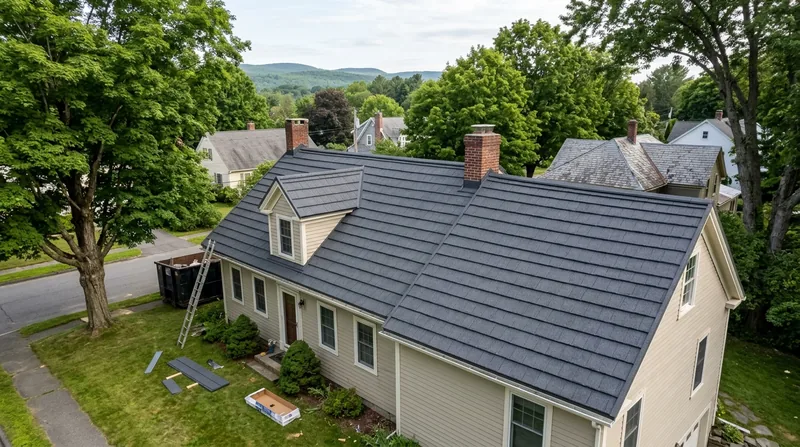




Stone-Coated Steel Roofing in Springfield
If you own a Victorian on McKnight, a triple-decker in Hungry Hill, or a 1990s Colonial out in Wilbraham, Stone-Coated Steel Roofing in Springfield gives you the look of slate, shake, or tile with the strength of steel underneath. This is a Connecticut River valley city where roofs take heavy snow, ice dams, nor'easters, and freezing rain, and where the memory of the June 2011 tornado still shapes how people think about wind uplift. Stone-coated panels lock down hard, shrug off hail, and hold a Class A fire rating. We install these systems on steep gables, deep eaves, and the mixed housing stock that defines the Pioneer Valley. If you are weighing a full replacement, start with our metal roof replacement page to see how the process works.
Why Stone-Coated Steel Makes Sense on Springfield's Older and Newer Rooftops
Springfield roofs sit in a freeze-thaw cycle that punishes asphalt shingles faster than most homeowners expect. Ice dams form along the deep eaves of McKnight Queen Annes and Forest Park bungalows, and falling limbs from mature maples and oaks crack shingle mats. Stone-coated steel handles that abuse without the brittleness, and it matches the historic profiles that design review boards expect.
- Hail and wind resistance that meets or exceeds most asphalt systems, which matters after the valley's storm seasons.
- Class A fire rating for the wood-frame triple-deckers and two-families common in Mason Square and Liberty Heights.
- Slate, shake, and tile profiles that fit the Italianate and Colonial Revival homes in the McKnight historic district.
- Lower dead load than actual slate, so older framing in Pine Point and Sixteen Acres carries it without reinforcement.
- Color retention through humid summers and bright snowy winters, without the granule loss asphalt shows after ten years.
For a city with this much historic housing stock, the finish options matter as much as the steel core.
Key info: A homeowner on a steep-gabled Colonial in Longmeadow replaced worn asphalt with a shake-profile stone-coated steel system and matched the original 1920s look while cutting ice-dam callbacks. Historic district and HOA review boards usually want a color and profile sample before approval, so we bring physical panels to the estimate.
Before you commit to any system, check the Massachusetts contractor registration rules through the Office of Consumer Affairs and Business Regulation and confirm local permit requirements with the Springfield building department.
How We Install Stone-Coated Steel on Springfield Homes, Step by Step
Stone-coated steel is not a screw-down panel job. Each course interlocks, and the underlayment and flashing do most of the water work. We start by inspecting the deck, because a 1920s Cape Cod in East Forest Park and a 2015 subdivision Colonial in West Springfield need different prep. Then we sequence the install around weather windows and the steep pitches common on valley Victorians.
- We tear off the existing roof down to the deck and inspect for rot, soft sheathing, and failed flashing at chimneys and skylights.
- We install a high-temp ice-and-water shield along the eaves and valleys, which is critical for ice-dam country.
- We lay synthetic underlayment across the field and set new drip edge and valley metal.
- We chalk lines and install the stone-coated panels course by course, locking each row and fastening to spec.
- We cut and fit hip, ridge, and valley trim, then seal penetrations at chimneys, vents, and skylights.
- We clean the gutters, magnet-sweep the yard, and walk the roof with you before we pull off the job.
Every step gets documented with photos, which helps if you ever file an insurance claim.
Local example: On a 1920s bungalow in Forest Park, the original deck had soft spots near the chimney from years of ice-dam backup. We replaced the sheathing, rebuilt the chimney flashing, and installed a shake-profile stone-coated steel system. The homeowner also added snow guards, which you can read about on our snow guards and ice protection page.
Stone-Coated Steel Approaches We Use in Springfield
Not every Springfield roof wants the same panel. The right choice depends on pitch, historic review, budget, and how visible the roof is from the street. Here is how the main approaches compare.
| Approach | Description | Best for |
|---|---|---|
| Shake-profile panels | Textured stone granules over steel with a wood-shake look and deep shadow lines. | Victorians and Colonials in McKnight and Longmeadow. |
| Slate-profile panels | Rectangular stone-coated tiles that mimic slate at a fraction of the weight. | Steep-gabled historic homes and churches. |
| Tile-profile panels | Curved or flat interlocking tiles with a Mediterranean or Spanish look. | Subdivision Colonials in Wilbraham and Agawam. |
| Heavy-gauge shake panels | Thicker steel core for high-wind and hail exposure. | Exposed hillside lots near Mount Tom and the Holyoke Range. |
We bring samples of each profile so you can see them against your siding in real daylight.
Stone-Coated Steel Roofing Cost in Springfield: What to Expect
Most stone-coated steel roofs in Springfield start around From $9 per square foot installed, and the final number depends on pitch, tear-off layers, deck repairs, and trim complexity. A simple ranch in Indian Orchard sits near the low end. A steep McKnight Victorian with turrets, valleys, and historic color review lands higher. Getting two or three written estimates is the smart move, because scope differences (underlayment, ice shield, flashing) drive price more than the panel brand.
- Roof size and pitch determine labor hours and safety setup on steep gables.
- Tear-off layers add disposal cost, and code limits how many layers can stay.
- Deck repairs for soft sheathing are common on pre-1950 housing stock.
- Flashing complexity at chimneys, skylights, and dormers changes the trim package.
- Profile and color choices range from standard shake to premium slate looks.
For a fuller breakdown of what moves the number, see our pricing overview.
Stone-Coated Steel Roofing Near Me: How to Vet a Contractor Near Springfield
You want a roofer who has worked the valley's housing stock, not a storm chaser passing through after a nor'easter. Ask for the state registration, a certificate of insurance, and local references you can call. Confirm who pulls the permit, because Springfield and surrounding towns handle roofing permits differently. If your home sits in a historic district or an HOA, ask how the contractor handles design review and color approval before anyone orders panels.
- Verify the contractor is licensed and insured, and ask for the certificate directly.
- Get two or three written estimates with the same scope so you can compare fairly.
- Ask for references from Springfield-area jobs with similar roof profiles.
- Confirm who handles the permit and the historic or HOA approval.
- Check that ice shield, underlayment, and flashing are itemized, not lumped in.
When you are ready to talk, reach us through our contact page and we will set up a free estimate.
Stone-Coated Steel Roofing in Springfield: Pricing Guide
| Service | Price | Details |
|---|---|---|
| Stone-coated steel roof replacement | From $9/sq ft | Installed with underlayment, ice shield, and trim; pitch and tear-off layers move the price. |
| Historic or complex profile install | On estimate | Steep gables, turrets, valleys, and design review add labor and trim complexity. |
| Deck repair and flashing rebuild | On estimate | Soft sheathing or chimney and skylight flashing work priced after an on-site inspection. |
| Travel | Included | In Springfield and surrounding Pioneer Valley towns, no separate mileage fee. |
| Estimate | Free | Response within 24h at (413) 266-5240, no obligation to book. |
Indicative pricing, the exact cost depends on square footage, finish, and site access. Free personalized estimate within 24h at (413) 266-5240.


